Short answer
A 12×12 dining room with 9-ft ceilings needs 2.2 gallons of wall paint for two coats — or 9 quarts if you're buying smaller cans. The ceiling adds another 0.41 gallons (one coat), and trim plus windows will run about 2 quarts. That's the answer to how much paint for a 12x12 dining room before rounding up for safety stock.
How this calculator works
The formula converts room dimensions into net paintable wall area, applies a realistic coverage rate, and multiplies by your coat count. Here's each step.
Step 1 — Gross wall area
The four walls of a rectangular room equal the perimeter times the ceiling height:
2 × (length + width) × height 2 × (12 + 12) × 9 = 432 sq ft
Step 2 — Subtract doors and windows
You're not painting doors or window glass, so the calculator removes those areas using standard sizes:
- 1 door × 21 sq ft = 21 sq ft
- 2 windows × 15 sq ft = 30 sq ft
Net paintable wall area: 432 − 21 − 30 = 381 sq ft
Step 3 — Multiply by coat count
Two coats means you're covering every square foot twice:
381 × 2 = 762 sq ft total paint coverage needed
Step 4 — Divide by coverage rate
The calculator uses 350 sq ft per gallon, a conservative figure for rolled application on normal drywall. Paint cans often advertise 400 sq ft/gallon, but that assumes a single thin coat in ideal conditions. In practice — slight texture, two coats, corners cut in — 350 is more reliable.
762 ÷ 350 = 2.18 gallons
Round that to 2.2 gallons for purchase planning.
Secondary outputs
The calculator also produces three additional figures you'll need at the store:
- Ceiling paint: 12 × 12 = 144 sq ft ÷ 350 = 0.41 gallons (one coat, which is standard for ceilings). A single quart won't quite cover it; pick up two quarts or grab a half-gallon if your store stocks them.
- Quart equivalents: Ceiling the main result times 4 gives you 9 quarts, useful if you're pricing out a color you haven't committed to in large quantity.
- Trim paint: 1 door + 2 windows = 3 openings × 0.25 quarts, plus 1 base quart = 2 quarts. This is an estimate for standard casings; add a third quart if your room has crown molding running the full perimeter.
What the calculator does not handle
A few things require human judgment:
- Accent walls. If one wall is a bold contrast color, split it out separately and calculate that wall's area alone.
- Heavy texture. Popcorn ceilings or sand-texture walls absorb 20–30% more paint. Drop the effective coverage rate to around 275–300 sq ft/gallon in those cases.
- Dark-to-light color changes. The formula assumes standard coverage. Going from navy to white realistically requires 3 coats even with primer, which you should input as
coats = 3. - New drywall. Fresh drywall is highly absorbent. Always prime first; the primer coat is separate from your finish coat count.
Rounding for purchase
2.2 gallons is not a package size you can buy. Buy 3 gallons (two for the bulk of the job, one as safety stock and future touch-ups). Store the remainder in a sealed can with a layer of plastic wrap under the lid to prevent skinning.
Common mistakes and gotchas
Recommended materials
For a job this size, you want a paint that lays down evenly in two coats without requiring a third trip around the room. A good roller cover makes a bigger difference than most people expect — a cheap roller sheds fibers and leaves a stippled surface that shows under lighting. Tape quality matters at trim lines, especially if you're using a satin wall color next to semi-gloss woodwork.
- Behr Premium Plus interior paint (1 gallon) — solid hiding power in eggshell or satin finishes; widely available for in-store color matching
- Purdy 9-inch roller cover (3-pack) — 3/8-inch nap works for standard drywall; the 3-pack covers a full two-coat room job without reusing a saturated cover
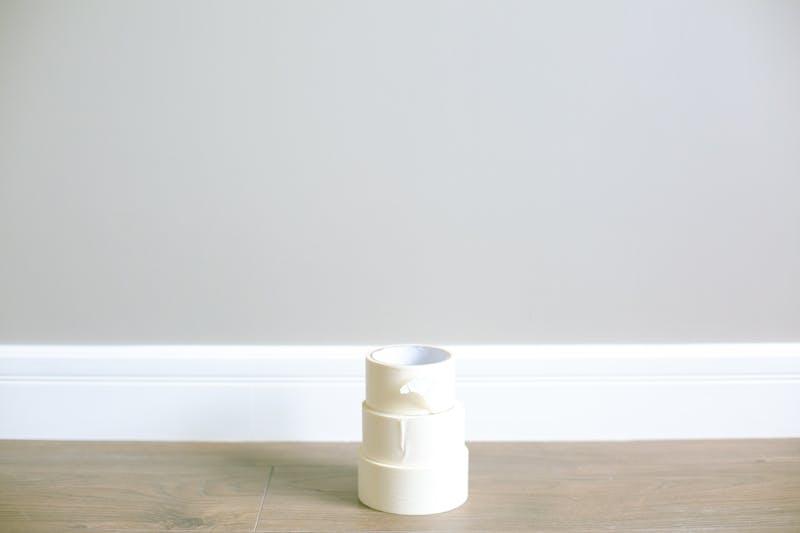
- Frog Tape painter's masking tape (1.41-inch x 60yd) — the polymer edge seal prevents bleed at trim lines far better than standard blue tape, worth the price difference on finished woodwork
FAQ
How many gallons of paint does a 12x12 dining room need? For two coats on the walls, a 12×12 room with 9-ft ceilings requires about 2.2 gallons. One door and two windows bring the net paintable area to roughly 763 sq ft across both coats.
Does that 2.2 gallons include the ceiling? No. The wall calculation and ceiling calculation are separate. A 12×12 ceiling is 144 sq ft, which takes about 0.41 gallons for one coat — less than a quart and a half.
How much paint for the trim and doors in a 12x12 room? Budget about 2 quarts for trim, doors, and window casings in a room this size. Trim paint is typically semi-gloss or gloss, so keep it separate from your wall color.
Why does the calculator subtract area for doors and windows? Standard interior doors run about 21 sq ft (3×7 ft) and average windows around 15 sq ft. Subtracting those from gross wall area gives you the actual surface you need to cover.
Is 350 sq ft per gallon a reliable coverage rate? 350 sq ft/gallon is a conservative real-world figure for a single coat with a roller on smooth drywall. Manufacturer specs often cite 400 sq ft, but that assumes ideal conditions — new roller, no texture, no dark colors.
Should I round up to 3 gallons instead of buying 2.2? Buying 3 gallons is the safer move. Paint stores can match the formula later, but a slight batch variation makes touch-ups visible. Having leftover paint stored in a sealed can is better than running short on the second coat.
How many quart cans equal the same amount as 2.2 gallons? You would need 9 quarts to cover the same volume as 2.2 gallons when buying in quart-sized cans. Gallons are almost always cheaper per ounce, so buy gallons unless you only need a small top-up amount.
Does ceiling height affect paint quantity significantly? Yes. Dropping from 9-ft to 8-ft ceilings on this same 12×12 room reduces wall area by about 96 sq ft, which saves roughly 0.55 gallons over two coats — close to a full quart per coat.
Do I need primer before painting a dining room? If you're making a dramatic color change, covering a stain, or painting new drywall, primer is not optional. On previously painted walls with a similar color, a self-priming paint-and-primer product can work in two coats.
What roller nap should I use for dining room walls? A 3/8-inch nap is standard for smooth to lightly textured drywall. Use 1/2-inch nap if the walls have any orange-peel or knockdown texture — it carries more paint into the low spots.
How long does it take to paint a 12x12 dining room? Expect 3–5 hours for a single-person crew doing two coats, including dry time between coats (usually 2–4 hours depending on the paint). Add 30–60 minutes for taping and prep.
Can I use the same paint for walls and ceiling? Technically yes, but ceiling paint is formulated to be more viscous and spatter-resistant, and it typically dries flat to hide roller marks. Using wall paint on ceilings often means more drips and a less even finish.