Short answer
A 1,200 sqft house with a 140-ft perimeter, 10-ft walls, 2 exterior doors, and 8 windows needs 7.1 gallons of exterior body paint for 2 coats on smooth siding. Buy 8 gallons to allow for a 10% waste buffer. You'll also need about 5 quarts of trim paint and 3.5 gallons of primer if you're doing a full prep-and-prime job.
How this calculator works
The calculator converts your house's physical dimensions into net paintable wall area, then divides by the paint's coverage rate and multiplies by your coat count.
Step 1: Gross wall area
Multiply the house perimeter by the wall height. For this house: 140 ft × 10 ft = 1,400 sqft of gross wall surface. This is the full exterior wall area before subtracting openings.
Step 2: Subtract doors and windows
Doors and windows don't get painted with body paint, so the calculator removes them. Each standard exterior door deducts 21 sqft (a 3×7 opening). Each window deducts 15 sqft (roughly a 3×5 opening). For this house: 1,400 − (2 × 21) − (8 × 15) = 1,400 − 42 − 120 = 1,238 sqft of net paintable area.
Step 3: Apply the siding factor
Different siding profiles hold different amounts of paint. Smooth surfaces (fiber cement, painted wood) use a factor of 1.0—no adjustment. Vinyl or lightly textured siding uses 1.1 because the grooves add surface area. Stucco or cedar shake uses 1.2 because the rough texture absorbs substantially more paint. This house uses 1.0 (smooth siding), so the area stays at 1,238 sqft.
Step 4: Divide by coverage rate and multiply by coats
Exterior paint covers approximately 350 sqft per gallon on a real surface. Manufacturers often advertise 400 sqft/gallon, but that assumes perfect conditions. Using 350 sqft/gallon is more realistic and protects against coming up short.
Formula: (1,238 × 2 coats × 1.0) / 350 = 7.07 gallons
Round up to 8 gallons when you place your order.
Secondary outputs
The calculator also gives you two related estimates:
Trim paint: Trim coverage is roughly 1 quart per 30 linear feet of perimeter. At 140 ft, that's 5 quarts (⌈140/30⌉ = 5). Trim includes fascia boards, window and door casings, corner boards, and any decorative molding—it all gets a different color in most paint schemes, so it's budgeted separately.
Primer: If you need to prime first—new siding, bare wood, a significant color change, or a chalky old surface—budget one coat at the same 350 sqft/gallon rate: 1,238 / 350 = 3.5 gallons of primer.
What the output doesn't cover
The calculator handles body paint (the main siding color) and gives estimates for trim and primer. It does not account for:
- Porch floors or ceilings (different paint products)
- Garage doors (large smooth panels—measure those separately)
- Masonry foundation areas if you're painting the block or brick
- Shutters, which are often removed and spray-painted separately
If any of those apply to your project, add them manually before placing your paint order.
A note on coats
Two coats is the standard for exterior work. One coat is defensible only when recoating the same or very similar color over clean, well-bonded existing paint. New construction, color changes, or any surface with fading, chalking, or staining needs two coats minimum to hit full opacity and durability.
Recommended materials
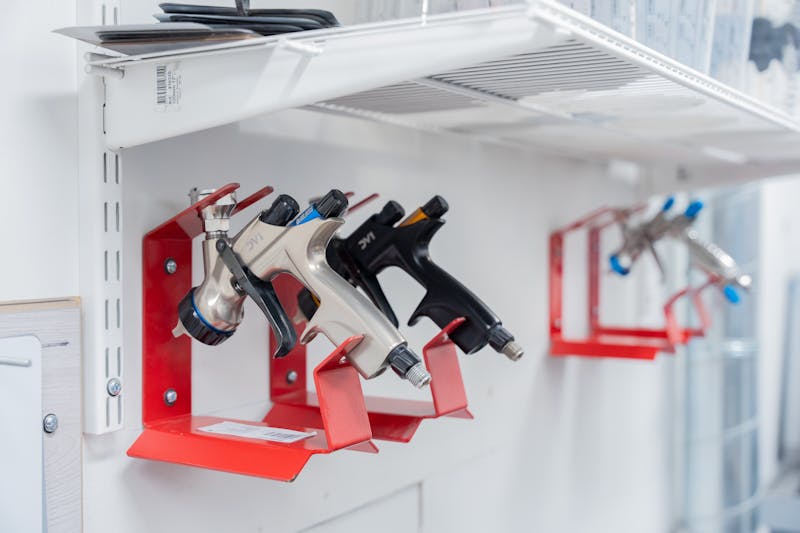
For a project this size, you want a high-build exterior paint that can hold up to UV exposure and moisture without needing a third coat. A premium acrylic latex is the right call for most residential siding. For application, an airless sprayer cuts time significantly on a full exterior job—just add 20–25% to your paint order to cover overspray, and always back-roll if the siding has any texture. A solid extension ladder is non-negotiable for safely reaching eaves and upper-story work.
- Behr Marquee exterior paint (1 gallon) — one-coat hide in most colors, lifetime warranty, available in flat, satin, and semi-gloss for trim
- Graco Magnum X5 airless paint sprayer — handles up to 125 gallons per year, adjustable pressure, works with unthinned latex
- Werner D1224-2 24-foot aluminum extension ladder — reaches a 20-ft eave with proper standoff, Type IA 300-lb rating
FAQ
How many gallons of exterior paint do I need for a 1200 sqft house? With a 140-ft perimeter, 10-ft walls, 2 doors, and 8 windows, you need about 7.1 gallons of body paint for 2 coats. Round up to 8 gallons to account for touch-ups and minor waste.
Does the square footage of the house equal the square footage of paintable wall area? No. A 1200 sqft house refers to floor area. The paintable wall area depends on perimeter, wall height, and the number of doors and windows subtracted out. For this house, the net paintable area is 1,238 sqft.
How much primer do I need for a 1200 sqft house exterior? One coat of primer on 1,238 sqft of wall area requires about 3.5 gallons. If you're painting over a similar color or using a paint-and-primer product, you may be able to skip a separate primer coat.
How many quarts of trim paint do I need? The rule of thumb is 1 quart per 30 linear feet of trim. For a 140-ft perimeter, that's 5 quarts. Trim includes fascia, window casings, door casings, and corner boards.
What coverage rate does exterior paint have? Most exterior paints cover 350–400 sqft per gallon on a smooth surface. This calculator uses 350 sqft/gallon, which is the conservative end of the range and more realistic on real-world siding.
Should I add a waste factor to my paint order? Yes. Order at least 10% more than the calculated amount. This covers spills, uneven application on textured surfaces, and leftover paint for touch-ups after the job.
How does siding type affect paint quantity? Rough or textured siding soaks up more paint. Smooth siding uses a factor of 1.0, vinyl or lightly textured siding uses 1.1, and stucco or cedar shake uses 1.2. Cedar shake can require up to 20% more paint than smooth siding.
Does a sprayer use more paint than a roller? Sprayers typically use 20–30% more paint than rollers due to overspray. If you're spraying, add that overspray waste on top of the calculated amount. Back-rolling after spraying also uses additional paint.
Can I get away with one coat of exterior paint? One coat is acceptable if you're applying a very similar color over sound, primed paint. For new surfaces, color changes, or faded or chalky old paint, two coats are the standard and give significantly better durability.
How do I calculate exterior paint for a two-story house? Use the actual wall height, not the story count. A two-story house typically has walls 18–22 ft tall. Enter that height into the calculator along with the full perimeter, and the math works the same way.
Are doors and windows subtracted from the wall area? Yes. Standard exterior doors are subtracted at 21 sqft each (roughly 3×7 ft) and standard windows at 15 sqft each. Custom or oversized openings may need manual adjustment.
How long does a gallon of exterior paint last in storage? An unopened gallon stored above freezing lasts 2–5 years. Latex paint that has frozen is usually ruined. Store leftover paint in a cool, dry interior space and press plastic wrap against the surface before sealing to extend shelf life.