Short answer
For a 2,000 sqft two-story home with a 180 ft perimeter and 18 ft wall height, you need about 17 gallons of body paint for two coats (16.95 gallons calculated). That figure is based on 2,967 sqft of paintable wall area after deducting 3 doors and 14 windows. You'll also need roughly 6 quarts of trim paint and, if priming, about 8.5 gallons of primer.
How this calculator works
The calculator takes six inputs and runs them through a straightforward area formula before dividing by paint coverage.
The inputs:
- Perimeter (ft): The total distance around the house at grade. For the 2,000 sqft two-story example, that's 180 ft.
- Wall height (ft): The average height of the walls from foundation to roofline, not including gable ends. Two-story homes typically run 18–20 ft.
- Number of exterior doors: Each standard door is treated as 21 sqft of non-paintable area.
- Number of exterior windows: Each window is treated as 15 sqft of non-paintable area. These are average figures — oversized windows or small transom windows will skew slightly, but they balance out across a typical house.
- Number of coats: Two coats is standard for an exterior repaint. One coat only makes sense when doing a touch-up or applying a dark color over a nearly identical base.
- Siding factor: This multiplier compensates for surface texture. Smooth-painted wood stays at 1.0. Vinyl lap siding goes to 1.1 because the channels and overlaps require slightly more paint. Stucco and cedar shake reach 1.2 because rough, porous surfaces soak up paint that never transfers to what you see.
The formula in plain English:
- Multiply perimeter × wall height to get the total raw wall area. For this house: 180 × 18 = 3,240 sqft.
- Subtract door area: 3 doors × 21 sqft = 63 sqft.
- Subtract window area: 14 windows × 15 sqft = 210 sqft.
- That leaves 2,967 sqft of paintable wall surface.
- Multiply by the number of coats: 2,967 × 2 = 5,934 sqft of total coverage needed.
- Apply the siding factor (1.0 for smooth siding, so no change here).
- Divide by 350 sqft/gallon: 5,934 ÷ 350 = 16.95 gallons, which rounds to 17 gallons.
The secondary outputs:
- Paintable wall area (2,967 sqft) is useful to have separately when comparing paint brands, since coverage rates differ by label.
- Trim paint (6 quarts) is estimated at 1 quart per 30 linear feet of perimeter — enough for fascia, corner boards, and window casings at two coats without going deep into a second bucket.
- Primer gallons (8.5 gallons) is calculated as one coat over the full paintable area. You only need this number if you're painting bare wood, switching from a dark to a light color, or dealing with staining from water damage or tannin bleed.
What the output does not include:
The calculator handles wall body paint and estimates trim and primer as secondary figures. It does not account for porch ceilings, foundation paint, shutters, or decorative accent colors. Those are small surface areas by comparison, but worth a few extra quarts if your design calls for them.
The 350 sqft/gallon rate is the conservative end of the typical range (most cans claim 350–400 sqft). Using the lower figure means you're more likely to have a small amount left over rather than running out on the last wall.
Recommended materials
For a project this size, you want paint that holds up to weather cycles without chalking or fading in the first few years. An airless sprayer pays for itself on a house with this much wall area, and a 24 ft extension ladder will reach the soffit line on most two-story walls without renting a lift.
- Behr Marquee exterior paint (1 gallon) — self-priming formula with solid hide in one coat when repainting similar colors; stock up in 5-gallon buckets for cost savings
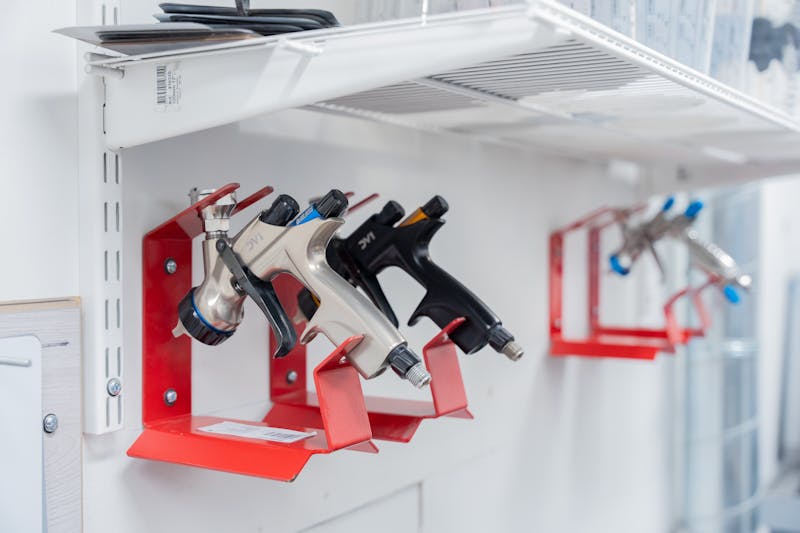
- Graco Magnum X5 airless paint sprayer — handles undiluted latex at full viscosity, which matters for exterior paints formulated to be thicker
- Werner D1224-2 24-foot aluminum extension ladder — reaches 18–20 ft eave lines and is light enough for one person to reposition across the full perimeter
FAQ
How many gallons of paint do I need for a 2000 sqft two-story house? For a typical two-story home with a 180 ft perimeter and 18 ft wall height, you need about 17 gallons of body paint for two coats. That accounts for deducting 3 doors and 14 windows from the total wall area.
Does the 17-gallon estimate include the trim? No. The body paint estimate covers only the siding. Trim — fascia, window casings, corner boards — is calculated separately at roughly 1 quart per 30 linear feet of perimeter, which adds about 6 quarts for a 180 ft perimeter house.
Do I need primer on top of those 17 gallons? If you're repainting over sound, same-color paint, primer is often optional. For bare wood, a dramatic color change, or stained siding, budget about 8.5 gallons of primer for one coat before your body paint.
Why does the calculator subtract area for doors and windows? Doors average about 21 sqft each and standard windows average about 15 sqft. Painting over those openings doesn't exist, so subtracting them prevents you from buying paint you won't use.
What is the siding factor and when does it change? The siding factor adjusts for surface texture. Smooth surfaces use 1.0, vinyl lap siding uses 1.1, and rough textures like stucco or cedar shake use 1.2 because porous or irregular surfaces absorb more paint per square foot.
How much does a gallon of exterior paint actually cover? Most exterior paints rate at 350–400 sqft per gallon on smooth surfaces. This calculator uses the conservative 350 sqft/gallon figure to avoid running short mid-project.
Should I round up to whole gallons when buying? Always buy in whole gallons and keep the extra sealed for touch-ups. Trying to mix a new batch to match sheen and color later is rarely perfect.
How does a two-story home compare to a single-story for paint quantity? A single-story home with the same perimeter but only 9 ft walls would need roughly half the paint. Wall height is the biggest driver of total paint volume — doubling height doubles the gallons required.
Can I use a roller instead of a sprayer for exterior work? A roller works fine on smooth or vinyl siding, but for textured surfaces like stucco or cedar shake, a sprayer cuts application time significantly and ensures better penetration into gaps. Either way, the gallon count stays the same.
Is there a waste factor built into this estimate? The calculator uses a conservative coverage rate of 350 sqft/gallon, which naturally builds in a small buffer. If your sprayer setup wastes more paint through overspray, add 10% to the total and round up.
How many gallons does one 5-gallon bucket cover? One 5-gallon bucket covers roughly 1,750 sqft on smooth surfaces. For this project's 2,967 sqft of paintable wall area with two coats (5,934 sqft total coverage), you'd need between three and four 5-gallon buckets.
Does wall height include gable ends? The calculator uses a flat average wall height and doesn't separately compute gable triangles. For homes with steep rooflines, measure the average height of each wall face and use that figure — or add 10–15% to your gallon count if the gables are large.