Short answer
A 60×40 house with a 4/12 pitch requires 25.3 roofing squares, covering 2,530 square feet of actual roof surface. At 3 bundles per square with a 10% waste factor, that's 84 shingle bundles, 7 underlayment rolls, and 200 linear feet of drip edge.
How this calculator works
The footprint of a 60×40 house is 2,400 square feet. But a sloped roof always covers more surface than the flat ground underneath it — how much more depends on the pitch. A 4/12 roof rises 4 inches for every 12 inches of horizontal run, and that slope stretches the surface area by a factor of 1.054. Multiply 2,400 sqft by 1.054 and you get 2,529.6 square feet of actual roof deck. Divide by 100 and you have 25.3 roofing squares.
The core formula
Roofing squares = (length × width × pitch_factor) / 100
                = (60 × 40 × 1.054) / 100
                = 2,529.6 / 100
                = 25.296 squares
That's the number you'd write on a purchase order or give to a roofing contractor for a bid.
Pitch factors at a glance
| Roof pitch | Pitch factor |
|---|---|
| 3/12 | 1.031 |
| 4/12 | 1.054 |
| 5/12 | 1.083 |
| 6/12 | 1.118 |
| 8/12 | 1.202 |
| 12/12 | 1.414 |
A 4/12 pitch is one of the most common choices on modern ranch and contemporary homes precisely because the factor is low — you're not paying a steep-pitch premium on materials or labor.
Shingle bundles
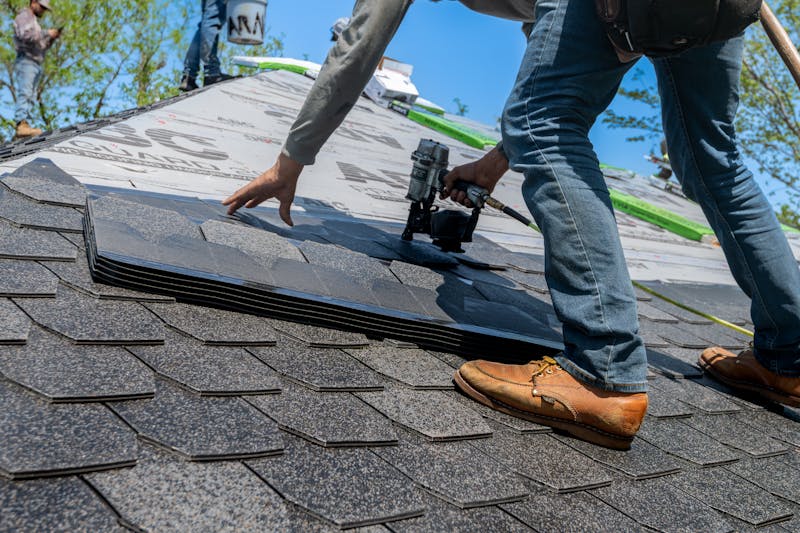
Most three-tab and architectural shingles ship 3 bundles per square. To find the bundle count, multiply the square count by 3, then add 10% for waste:
Bundles = ceil(25.296 × 3 × 1.10) = ceil(83.48) = 84 bundles
The waste allowance covers end cuts, starter course, and the inevitable dropped or damaged piece. For a simple gable roof, 10% is appropriate. Hip roofs and roofs with multiple valleys warrant 15%.
Underlayment rolls
Synthetic underlayment rolls typically cover 10 squares (1,000 sqft). The calculator uses a 4-square roll for conservative planning. For this roof:
Rolls = ceil(25.296 / 4) = ceil(6.32) = 7 rolls
If your product covers more area per roll — GAF FeltBuster, for example, covers 10 squares — you'll need fewer rolls. Confirm the roll coverage on the label before ordering.
Drip edge
Drip edge runs along every eave and rake edge. For a simple rectangular footprint the perimeter is:
Perimeter = 2 × (60 + 40) = 200 linear feet
Buy in 10-foot sticks (20 sticks), plus 2–3 extra for corners and cuts. On a hip roof, the rake edges become hip edges; the perimeter math stays the same.
Ridge cap
Ridge cap shingles cover the peak. A rough rule of thumb is that ridge length equals about 10% of total roof area. For this roof:
Ridge cap = ceil(25.296 × 0.10) = ceil(2.53) = 3 squares
Pre-cut ridge cap bundles cover roughly 20 linear feet per bundle. Measure your actual ridge and hip lengths for a tighter number.
What the calculator does not include
- Starter strip — typically 1 bundle per 100 linear feet of eave
- Flashing — step flashing at walls, chimney flashing, pipe boots
- Ventilation — ridge vent or box vent cutouts
- Decking repairs — replace rotted sheathing before you shingle
These items don't change the square count, but they will show up on your material list.
Recommended materials
For a 25-square roof, you want shingles that will actually cover the rated area per bundle, underlayment rated for your climate, and drip edge that won't corrode. Architectural shingles have largely replaced three-tab because the layered profile handles wind uplift better — critical on a low-slope roof that sees more lateral wind load than a steep one. Synthetic underlayment installs faster and stays flat longer than felt, which matters when the shingles go on days later.
- GAF Timberline HDZ architectural shingles (33.3 sqft per bundle)
- GAF FeltBuster synthetic underlayment (10 sq roll)
- Amerimax Home Products 10 ft white drip edge
FAQ
How many roofing squares does a 60x40 house with a 4/12 pitch need? It needs 25.3 roofing squares, covering 2,530 square feet of roof surface. That accounts for the 4/12 pitch factor of 1.054 applied to the 2,400 sqft footprint.
What is a roofing square? One roofing square equals 100 square feet of roof surface. Contractors price materials and labor in squares because it keeps the numbers manageable on large jobs.
What pitch factor should I use for a 4/12 roof? Use 1.054 for a 4/12 pitch. This multiplier converts your flat footprint area to the actual sloped surface the shingles must cover.
How many shingle bundles do I need for a 60x40 roof at 4/12? Plan on 84 bundles, which already includes a 10% waste factor. Most architectural shingles like GAF Timberline HDZ come 3 bundles per square, covering about 33.3 sqft per bundle.
How many underlayment rolls do I need? You need 7 rolls of underlayment, based on each roll covering 4 squares (400 sqft). This assumes a full-coverage single layer, which is standard for most residential installs.
How much drip edge do I need for a 60x40 house? The perimeter of a 60×40 footprint is 200 linear feet, so you need 200 linear feet of drip edge. Buy in 10-foot sticks and add a few extra for cuts at corners.
What is ridge cap and how much do I need? Ridge cap shingles cover the peak where two roof planes meet. For this roof, plan on 3 squares of ridge cap, which is roughly 10% of the total roof area.
Does a 4/12 pitch count as a low-slope or steep roof? A 4/12 pitch is considered a low-to-moderate slope. It falls well above the 2/12 minimum for standard architectural shingles and doesn't require special low-slope products.
Should I add waste factor on top of the 84 bundles? No. The 84-bundle figure already includes a 10% waste allowance. For complex rooflines with multiple valleys or hips, bump the waste factor to 15% and recalculate.
Is the 60x40 measurement the house footprint or the roof surface? It's the house footprint — the floor plan dimensions. The calculator multiplies by the pitch factor to find actual roof surface area, which is larger than the footprint.
How do valleys and dormers affect the square count? Each valley adds waste from diagonal cuts, and dormers add both extra surface area and additional cut waste. Add 5–15% on top of the base calculation for roofs with these features.
Can I use this calculation for a metal roof? The square footage and roofing square count are the same regardless of material. Metal roofing is sold by the square as well, but panel overlap and trim details change the exact quantity — consult your panel manufacturer's coverage specs.